

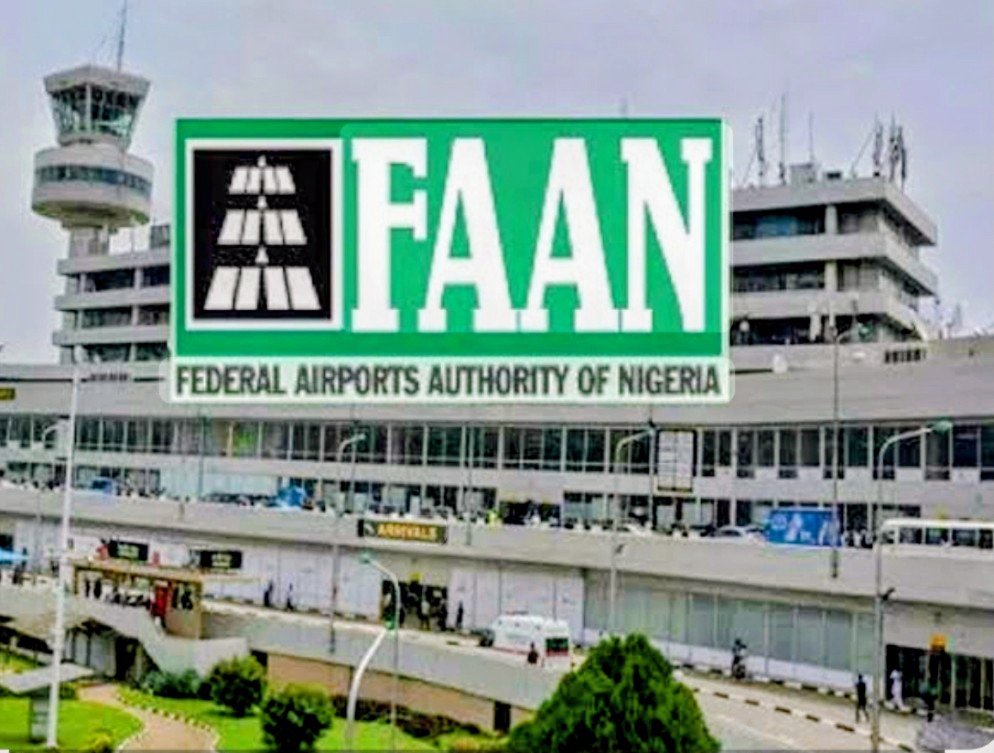

Security forces are on high alert over planned attacks on airports and prisons.
Following fresh intelligence indicating a planned terrorist attack targeting key infrastructure in Nigeria, including the country’s airports, security experts have raised alarms about the vulnerability of the nation’s aviation facilities.
A source close to the Federal Airports Authority of Nigeria (FAAN) said the agency is working around the clock to close loopholes but declined to disclose specific measures.
A retired aviation security expert, John Ojikutu, warned that major airports still have critical gaps, especially in perimeter and security fencing.
Ojikutu explained that airport security involves six key levels: intelligence sharing, passenger pre-screening, check-in and baggage screening, access control, passenger checkpoint screening, and boarding gate screening.
He emphasized that failure in any of these stages, particularly intelligence, could allow threats to go unnoticed and escalate into national disasters.
He also pointed out the difference between basic perimeter fencing and security fencing compliant with international standards.
Ojikutu referenced standards set by the International Civil Aviation Organization (ICAO), noting that while many Nigerian airports have perimeter fences, they often do not meet the enhanced security fencing standards in ICAO’s Annex 17 and Document 8973.
He stated that Nigeria has yet to fully implement recommendations from past ICAO audits, some dating back to 2004.
Recent ICAO assessments, especially at Lagos airport, have identified structural risks, notably the layout along a single axis that increases vulnerabilities.
He said, “There are standards for all airlines and airports. If intelligence fails, any of these could fail, and the threat could be onboard and turn into a national disaster even with onboard security.
“Perimeter Fence (Annex 14) is not a Security Fence (Annex 17). There may be a perimeter fence at an airport, but if not, it has not fulfilled the provision for a security fence in Document 8973.
“Lagos Airport has a perimeter fence, not an enhanced security fence, and the ICAO Audit Report of 2004 said so, and we are yet to comply. So are many of our airports.
“Last year, ICAO identified the risks posed by the structural development along one side of our airports, especially Lagos, which threaten security. I am not sure, beyond tollgate issues, whether the aviation and airports authorities have seriously addressed this since last year.”
Meanwhile, a source close to the Ministry of Aviation and Aerospace Development assured that the government is taking critical measures to mitigate risks.
According to the source, airport authorities, including FAAN, are collaborating closely with security agencies, sharing intelligence, and implementing safety protocols to protect vital infrastructure.
The source also revealed that perimeter fencing projects are underway at at least four major airports under the government’s Renewed Hope Initiative.
He declined to specify project details, citing security concerns, and said, “it’s a security issue. We can disclose that on the pages of the newspaper.”
Also, aviation expert Charles Amokwu pointed out that Nigeria has been fortunate in aviation security so far.
He mentioned last month’s bandits’ attack at Akure Airport and emphasized the need for more stringent security measures.
Amokwu also highlighted repeated security breaches at Kaduna, Lagos, and other major airports, urging better coordination among security agencies.
He warned, “The customs’ warning should serve as a wake-up call, rather than just routine intelligence. Since airports are gateways to the economy and international travel, any attack could have serious consequences for national security, investor trust, and Nigeria’s image globally.”
An internal Nigeria Customs Service (NCS) memo dated April 13, 2026, disclosed a “credible report” that insurgent groups, including Boko Haram and Islamic State West Africa Province, were planning coordinated attacks within the Federal Capital Territory (FCT) and nearby areas.
Potential targets listed include Nnamdi Azikiwe International Airport (NAIA), Abuja, the Kuje Correctional Center, and the Wawa Military Prison in Niger State.
The memo suggested that ISWAP operatives might have already infiltrated the FCT to facilitate these attacks.