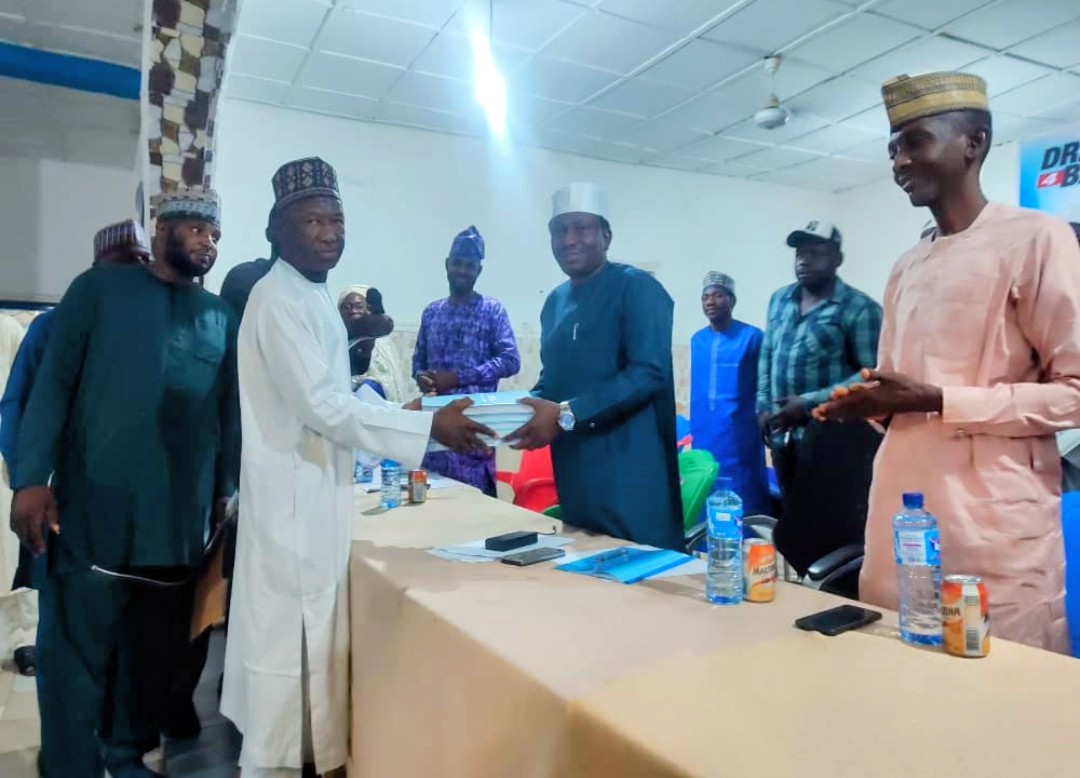

Chanchaga transition committee presents report, recommends security, financial and governance reforms
By Our Correspondent.
The Transition Committee of Chanchaga Local Government Area has presented its report to the Chairman-elect, Dr. Mustapha Jibrin, recommending sweeping reforms across security, finance, administration, agriculture, education and primary healthcare.
Presenting the report in Minna, Chairman of the Committee, Alhaji Isa Abdulkadir, said the team worked diligently for three weeks after being inaugurated on Nov. 19 by the Acting Chairman, Hon. Isah Mohammed.
He said the committee divided itself into three sub-committees that undertook document reviews, project inspections, personnel verification and financial assessments.
Abdulkadir explained that the report spanned 40 pages and contained detailed departmental reviews, handover notes, findings and priority recommendations designed to guide the incoming administration.
He said the committee established clear baselines for each department following extensive engagements with directors and unit heads.
He said the committee recommended a comprehensive “security reset” for the local government, emphasising stronger coordination of community structures, intelligence-driven operations and reinforcement of safety systems at ward and neighbourhood levels.
According to him, insecurity had weakened public confidence and affected economic activities across several communities.
On financial management, Abdulkadir said the committee advised the establishment of a single treasury framework, full automation of revenue systems, forensic audits of liabilities, and elimination of leakages.
He said weak internal controls, fragmented receipts and undocumented liabilities were major concerns requiring urgent corrective action.
The committee further recommended restoration of market order in Chanchaga, recovery of encroached public spaces and strict enforcement of planning regulations.
Abdulkadir said institutionalising market governance would curb disorderly trading, improve sanitation and boost internally generated revenue (IGR).
He said emergency interventions were required in education and primary healthcare, particularly in rehabilitating dilapidated facilities, restoring water and electricity, strengthening laboratories and ensuring accountability for revenue generated by public health facilities.
He added that most schools and PHCs were operating below acceptable standards.
Abdulkadir also highlighted the need for restructuring the local government’s human resource system, enforcement of minimum attendance, capacity development and digitisation of staff records.
According to him, inefficiency in personnel management contributed to poor service delivery.
On agriculture, he said the committee recommended revival of slaughterhouse and cattle market systems, reactivation of idle equipment and enhanced partnerships with development agencies.
He noted that with proper organisation, the agricultural sector could significantly increase revenue and support livelihoods.
“We present to you a report born out of courage, discipline and belief that Chanchaga must work again.
“We expressed confidence that the recommendations would reposition the council for improved governance,” he said.
Responding, Chairman-elect, Dr Mustapha Jibrin, commended the committee, describing its work as detailed, thorough and patriotic.
He said the transition document was a valuable guide that captured the realities of the council and the expectations of citizens.
Jibrin said his administration would prioritise infrastructure upgrades, staff development, social development programmes and agricultural expansion, particularly in collaboration with the Bank of Agriculture and other development partners.
He added that the incoming government would focus on quick-impact interventions within its first 15 months.
He said the council would work with both local and international partners to strengthen the healthcare system and explore the deployment of NYSC medical